Auckland is New Zealand’s largest city and a major centre for business, culture and creative industries. Its neighbourhoods reflect Māori, Pacific and international influences across food, music, art, events and everyday life. Students can explore waterfront precincts, markets and festivals, while beaches, islands and walking trails are located within reach of the city. Auckland combines the opportunities and variety of a large urban centre with access to the outdoor experiences for which New Zealand is known.

Aotearoa New Zealand
Why study in New Zealand?
Aotearoa New Zealand is one of the world’s most peaceful countries, maintaining a high ranking in the Global Peace Index. It is one of the safest countries in the world for international students. With abundant natural beauty and world-class universities, students are offered a quality-assured education system and a relaxed outdoor lifestyle. Eligible graduates can also stay and work in New Zealand for up to 3 years after finishing their studies.
Quality assurance
The New Zealand Qualifications Authority (NZQA) ensures consistent standards across every institution.
Safe and welcoming
New Zealand consistently ranks among the world's safest nations, with diverse communities that make it easy to settle in.
Natural beauty
Beaches, mountains, forests and adventure sports are all within easy reach.
Flexible study pathways
Choose from English language, foundation, diploma, Bachelor's, Master's, MBA and PhD programmes.
Generous work rights
Eligible graduates can apply for a Post-Study Work Visa and work in New Zealand for up to 3 years.
Transparent visa system
New Zealand's student visa process is known for being clear, predictable and well supported.
Study destinations

Auckland
Hamilton
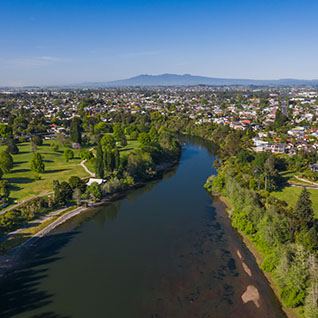
Hamilton is a growing inland city centred around the Waikato River, with a connected university community and a more relaxed pace than New Zealand’s largest cities. Students can explore the river paths and Hamilton Gardens, while the wider Waikato region offers access to mountains, coastline and outdoor activities including hiking, surfing, mountain biking and rowing. The city provides substantial everyday amenities while allowing students to live and study within a compact university environment.

Christchurch
Christchurch is the South Island’s largest city, combining an established university environment with renewed urban spaces and access to coast, mountains and regional landscapes. Students can explore Riverside Market, the Botanic Gardens and Hagley Park, alongside the city’s food, cultural events and community activities. Beyond the city, walking trails, beaches and outdoor experiences such as mountain biking, paragliding and skiing place regional adventure within reach.
Image Slider


Essential study information
Visas: what you will need
Most international students need a Fee Paying Student Visa to study in New Zealand full-time for longer than 3 months. It can be issued for up to 4 years, though it may run for a shorter period than your course. To apply, you will typically need:
- An offer of place from an approved New Zealand education provider
- A completed Financial Undertaking for a Student form, showing you can cover your fees and living costs
- Proof of identity, such as a valid passport
- Evidence you meet your provider’s English language requirements
- A medical certificate, in certain circumstances
- A police certificate, in certain circumstances
- Proof of guardianship, if you are studying as a minor
You will also need to pay a visa application fee, plus the International Visitor Conservation and Tourism Levy (IVL). It is worth checking the total for current fees before you apply.
Work rights
Most Fee Paying Student Visas come with work rights built in – check your visa conditions to confirm. You can generally work part-time for up to 25 hours a week while classes are running, and full-time during scheduled study breaks. If you are under the age of 18 and studying at a tertiary provider, you will need specific permission on your visa to work.
Post-Study Work Visa
After you graduate, you may be able to apply for a Post-Study Work Visa to stay and work in New Zealand for up to 3 years, depending on the qualification you completed. If you hold a Bachelor’s degree or higher (NZQF Level 7+), you can work for any employer in any job; graduates of some lower-level qualifications must work in an occupation related to their study. You can only ever be granted one Post-Study Work Visa.
From 16 November 2026, eligibility is being extended to more graduates, including some Graduate Diploma (Level 7) and Master’s degree (Level 9) holders, and a new Short Term Graduate Work Visa is opening for eligible graduates who do not qualify for the full Post-Study Work Visa.
Cost of living
On top of tuition fees, international students in New Zealand typically spend NZD 1,200-2,500 per month on living costs. Expenses will vary depending on the city, accommodation type and lifestyle. Auckland and Wellington tend to be the most expensive, mainly due to higher rent and transport costs. Regional cities like Dunedin and Rotorua are generally more budget friendly.
Immigration New Zealand requires students to show access to NZD 20,000 per year (around NZD 1,667 per month) to cover living costs, though many students – especially in Auckland – budget closer to NZD 22,000-35,000 to be realistic.
Health and safety
New Zealand is considered one of the safest and healthiest study destinations in the world. Every university, polytechnic, school and private provider enrolling international students is legally required to follow the Tertiary and International Learners Code of Practice. This framework protects your physical safety, mental wellbeing, accommodation standards, emergency support and access to healthcare – with NZQA monitoring compliance.
All international students must also have appropriate medical and travel insurance for the full length of their stay. Policies typically cover, as a minimum:
- Hospitalisation and surgery, public or private
- GP and specialist visits
- Prescription medicines
- Diagnostic tests, such as X-rays, blood tests and scans
- Emergency ambulance services
- Accidental dental treatment (not routine dental care)
- Repatriation
- Travel insurance elements, such as lost luggage, delays and personal liability
New Zealand’s Accident Compensation Corporation (ACC) also covers the cost of treatment for accidents and injuries for anyone in the country, including international students. ACC does not cover illness, routine care or specialist treatment. Which is why separate health insurance is still required.
Quality assurance
New Zealand’s education system is backed by the New Zealand Qualifications Authority (NZQA), which maintains quality of institutions and qualifications across the country. It ensures the consistency of academic standards for wherever you choose to study.