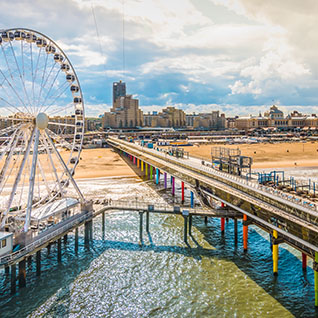
The Hague is an international city combining government, law and global organisations with cultural attractions and easy access to the coast. Students can explore the historic Binnenhof area, visit museums and galleries, or spend time at Scheveningen beach and the city’s parks. Extensive cycling routes and public transport make it straightforward to move around, while rail connections place cities including Rotterdam, Leiden and Amsterdam within reach. Its international outlook and more compact scale offer a distinctive alternative to the Netherlands’ larger cities.

The Netherlands
Why study in the Netherlands?
The Netherlands offers a world-class education with an open-minded teaching style and an international focus. Students from over 160 countries have travelled to earn their degrees at Dutch institutions.
Located centrally, the Netherlands is one of the safest and happiest countries in the world. Travelling to other destinations in Europe is as easy as boarding a train. Studying here provides access to a centre of innovation, top-tier education opportunities, and hubs for international communities.
An inclusive society
Home to world-leading museums and historic cities to explore.
Strong career prospects
Dutch industries have a variety of opportunities for graduates.
Unrestricted work rights
Graduates can stay and work freely under the Orientation Year visa for 12 months.
A hub for innovation
Future-focused industries and a teaching style built around collaboration and problem-solving.
Well-connected
An extensive, punctual public transport network and world-leading cycling infrastructure.
Quality of life
Top-tier scores for safety, healthcare, environment, climate and purchasing power.
Student cities in the Netherlands
The Hague
Enschede
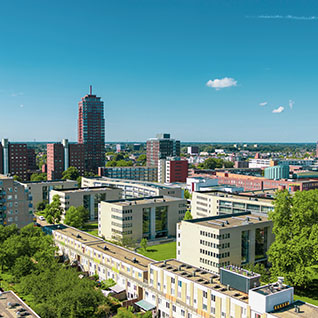
Enschede is a student-focused city in the eastern Netherlands, close to the German border and home to a growing technology and innovation community. Students can explore the city centre, visit local markets and cultural venues, or use the area’s cycling routes, parks and green spaces. Its compact scale makes everyday travel manageable, while rail connections provide access to other Dutch cities and nearby Germany. Enschede provides a quieter alternative to the Netherlands’ larger urban centres, with university life playing a visible role in the city.
Image Slider

Essential study information
Visas: what you will need
If you are a non-EU/EEA student studying in the Netherlands for more than 90 days, you will need a Residence Permit for Study and, if required by your nationality, an entry visa (MVV). Both are usually applied for together through the TEV (Entry and Residence) procedure. Your university – as an IND-recognised sponsor – submits the application on your behalf. Key requirements include:
- An offer from a recognised Dutch institution
- Proof of financial means
- Health insurance
- Academic documents in English, Dutch or German, or officially translated
- Proof of English language proficiency
- An antecedents certificate (criminal-record declaration)
- An application fee, paid via your institution
- A valid passport
Work rights
Non-EU/EEA students can work up to 16 hours a week during the academic year or full-time in June, July and August – you have to choose one option. You can not exceed 16 hours a week when it is not summer, even during exam periods. Your employer applies for a work permit (TWV) on your behalf. Mandatory internships that are part of your course do not count towards this limit, but need a separate internship agreement. English-speaking roles are common, particularly in major cities, but basic Dutch can help for some jobs.
EU/EEA and Swiss students have the same rights as Dutch students: unrestricted hours, no permit required, at any time of year.
After graduating, you can apply for the Orientation Year (Zoekjaar) – a 12-month post-study work visa that allows you to work in any job, without restrictions or needing employer sponsorship, while you look for a skilled role in your field. You can apply within three years of finishing your degree, giving you flexibility if you want to return home temporarily first.
Cost of living
Living costs in the Netherlands are relatively high compared with many other European destinations, so it is worth budgeting carefully.
Accommodation is usually the biggest cost. Public transport is efficient and extensive, and many students cut costs further by cycling.
To get a Dutch student visa or residence permit, you must show you have sufficient financial means to support yourself: €13,570 for one year, or €1,130.77 per month. This does not include tuition fees, which are usually shown separately or paid in advance to your university.
Health and safety
All international students in the Netherlands are legally required to have health and liability insurance in place before they arrive. The right level of cover depends on factors like nationality, age, residence status and whether you have a job. Good student insurance should cover urgent medical care and emergency hospital treatment.
EU/EEA students can often use a European Health Insurance Card (EHIC) from their home insurer for emergency-only cover in the Netherlands, for a duration that depends on their home country.
Students with a part-time job or paid internship must take out Dutch public basic health insurance (basisverzekering), which covers GP visits, hospital care, emergency treatment, prescriptions and maternity care. Some students also qualify for a monthly healthcare allowance (zorgtoeslag).
Quality assurance
Quality assurance for Dutch higher education is centralised and robust. All recognised programmes are accredited by the Accreditation Organisation of the Netherlands and Flanders (NVAO), and degrees are aligned with the European Higher Education Area. Bachelor’s and Master’s degrees follow the Bologna framework, ensuring international recognition and academic comparability across Europe.