Leipzig is a compact and culturally rich city with a strong musical heritage, growing creative industries and a more manageable pace than Germany’s largest capitals. Students can explore the historic Old Town, visit St Thomas Church and discover the city’s long connection with Johann Sebastian Bach. Leipzig also has active arts districts, music festivals, parks, lakes and green spaces, while its growing IT, logistics, media and creative sectors contribute to a changing employment landscape.

Germany
Why study in Germany?
Higher education in Germany is renowned for top-quality teaching and an education style that prioritises practical, work-focused learning experiences. The country is home to a booming job market and is one of the global hubs for the industries of tech, IT, engineering, science, and more. German cities are safe, diverse and welcoming. In Germany, students experience a first-class university education and a contemporary lifestyle, right in the heart of Europe.
High-quality education
Strong academic reputations and rigorous, government-backed quality standards.
A central European hub
Germany borders nine countries, making it easy to explore the rest of Europe.
Generous work rights
An 18-month visa allows graduates to work while they look for a role in their field.
Safe and stable
Germany often ranks highly for safety on the Global Peace Index.
Rich culture
Traditions, festivals and historic landmarks are never far away.
Strong career prospects
Skills shortages across German industries create real demand for graduates.
Germany’s student cities
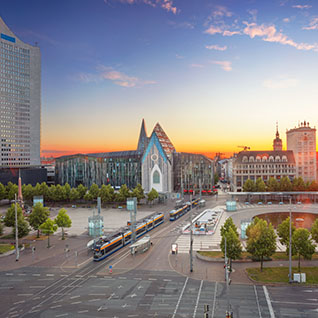
Leipzig
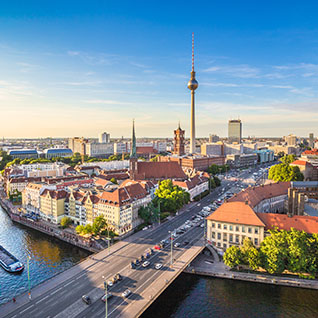
Berlin
Berlin is Germany’s capital and an international centre for history, creative culture and innovation. Students can visit Museum Island and major historic landmarks, explore creative neighbourhoods such as Kreuzberg or experience events including the Berlin International Film Festival and Festival of Lights. The city’s museums, galleries, music, nightlife and international communities create a wide range of experiences, while extensive parks, lakes and public spaces offer places to spend time away from its busier urban areas.
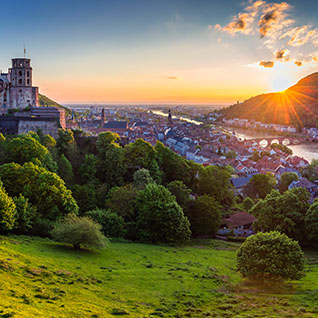
Heidelberg
Heidelberg is a historic university city known for its riverside setting, old town and international academic community. Students can explore Heidelberg Castle, walk through the historic centre or spend time along the Neckar River. The city hosts markets, cultural events and festivals throughout the year, including the Heidelberger Frühling classical music festival. Its compact scale and large student population create a distinctly university-focused environment, with Frankfurt and other parts of Germany accessible through regional transport connections.
Image Slider


Essential study information
Visas: what you will need
If you are planning to study in Germany for longer than 90 days you will need a National Visa (D-Visa), followed by a residence permit after you arrive.
To apply, you will typically need:
- An offer from a recognised German university, Studienkolleg, or other higher education institution
- Proof of financial resources
- Valid health insurance
- An APS Certificate for applicants from certain countries including India, Pakistan, China and Vietnam
- Academic documents including certificates, transcripts and a CV
- Proof of language proficiency (IELTS, TOEFL or PTE for English-taught programs)
- A completed application form and the visa fee
- A valid passport
- Proof of accommodation
Work rights
Non-EU/EEA students may work up to 140 full days or 280 half-days per year during term time (roughly 20 hours a week) plus full-time during semester breaks. Mandatory internships don’t count towards this limit.
Local EU/EEA and Swiss students have the same rights as German students: up to 20 hours a week in term time, and unlimited hours during holidays.
To work legally and be taxed correctly, every resident – including international students – needs a Tax Identification Number, which is posted to you after you register your address in Germany.
After graduating, you can apply for an 18-month post-study work visa, giving you time to work in any job – not just your field – while you search for a qualified role. Opportunities are open in Germany and across Europe.
Cost of living
To obtain a German student visa, you’ll need to show access to €992 per month (€11,904 per year) to cover living costs. Real-world expenses vary by city and lifestyle, but Germany remains more affordable than many other major study destinations.
Health and safety
Health insurance is mandatory for all international students in Germany – you can not enrol at a university, get a residence permit, or receive medical treatment without valid cover. For a fixed student rate of around €148 per month (2026), you get full access to Germany’s public healthcare system, one of the most advanced in the world.
Students from EU/EEA countries with a European Health Insurance Card (EHIC) or S1 certificate usually don’t need extra cover, as their home-country insurance is recognised in Germany.
Public medical insurance typically covers GP and specialist appointments, hospital treatment (including surgery), emergency care, mental health treatment, prescription medication, maternity care, and mandatory long-term care insurance.
Quality assurance
Germany uses a multi-layered quality assurance system that combines national regulation, state oversight and independent expert review. All accredited programs go through strict external evaluation. The official national body that decides whether degree programs and universities meet the required academic standards is the Akkreditierungsrat (German Accreditation Council).